Conrad’s Places
In Spring 2024, I taught for the first time a course in Digital Humanities called Computational Literary Studies. It was the usual mix of “Big Data” approaches and tools for literary analysis: readily accessible tools like Voyant and Google Ngrams, concordancing with Laurence Anthony’s AntConc, topic modeling, network analysis, with some rudimentary statistics thrown in. We were a small group — despite my efforts to create an English course that satisfied my college’s quantitative reasoning requirement, I ended up with only four students — so we decided to run the course more like a laboratory (with all due respect to the Stanford Literary Lab) and work on a project as a class. I had somewhat arbitrarily assigned Joseph Conrad’s Heart of Darkness as a common text on the assumption that most students would be familiar with it, and it was a good candidate for DH work: there is a fairly large Conrad corpus, all written before the 1929 copyright cutoff. In an effort to engage in what Matthew Jockers calls “macroanalysis,” moving between close and distant reading, Heart of Darkness could serve as our local instance of a larger corpus susceptible to computational methods.
During the course of our study of Heart of Darkness, members of the lab were drawn to Chinua Achebe’s famous critique of Conrad in “An Image of Africa.” Achebe’s well-known pronouncement that “Joseph Conrad was a thoroughgoing [‘bloody’ in the original] racist” derives, in no small part, from the way the latter treats Africa as a kind of abstraction:
Quite simply it is the desire — one might indeed say the need — in Western psychology to set Africa up as a foil to Europe, as a place of negations at once remote and vaguely familiar, in comparison with which Europe’s own state of spiritual grace will be manifest. [...] Heart of Darkness projects the image of Africa as “the other world,” the antithesis of Europe and therefore of civilization, a place where man’s vaunted intelligence and refinement are finally mocked by triumphant bestiality. The book opens on the River Thames, tranquil, resting peacefully “at the decline of day after ages of good service done to the race that peopled its banks.” But the actual story will take place on the River Congo, the very antithesis of the Thames. The River Congo is quite decidedly not a River Emeritus. It has rendered no service and enjoys no old-age pension. We are told that “going up that river was travelling back to the earliest beginning of the world.”
While the bulk of Achebe’s critique concerns Conrad’s depiction of African people, here he focuses his attention on the corollary territorial imagination: in the same way that Hegel could characterize Africa as “lying beyond the day of self-conscious history,” Conrad imagines it as a place without place — a kind of non-place, lacking in all of the geographical specificity that accompanies “civilization.” That places have proper names is, to this way of thinking, a sign of social “maturity.” But inasmuch as Africa represents this “foil” for the European-Eurocentric imagination, then its place-names (even if it had them) would be irrelevant — a level of particularity not required by the fantasy of “negation.”
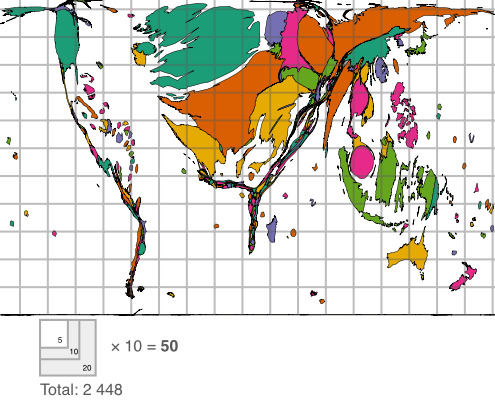
This led the lab to formulate a preliminary research question: if Achebe’s judgment is correct, and if Africa represents an abstract place without geographical specificity, then we should expect to find a lower incidence of place-names pertaining to Africa than we do to Europe; this is certainly evident, as the above passage suggests, in Heart of Darkness‘s invocation of the Thames, named far more clearly than the text will ever name the Congo. But, from a DH perspective, can we also generalize that same judgment across the entire Conrad corpus? In short, which place-names are most frequently occurring in all of Conrad’s texts, and how does that quantitative measurement interface with Achebe’s critique?
Methodology
We constructed a corpus of all of Joseph Conrad’s texts available on Project Gutenberg as text files. After some deliberation and research, we decided to eliminate the three novels that Conrad co-authored with Ford Maddox Ford, as those appear to be written more by the latter than the former. The group also decided to keep Conrad’s nonfiction writings — memoirs, prefatory notes, reflections, etc. — in the corpus. Texts were stripped of all artifacts of their digital production (licenses and the like) to leave only the original, published text of each work in place.
From there, we extracted all of the place-names from the corpus using Named Entity Recognition in the spaCy package in Python. Admittedly, such extraction is prone to a high degree of error, in the form of both false positives (misidentification of non-place-names) and false negatives (omitted place-names). But, well, you’ve got to dance with the date that brung ya; for our purposes, it was good enough to generate a reasonably workable dataset. False negatives, we could do nothing about; but false positives could be handled by hand-checking the 1600-odd entries we retrieved.
The lab then set about the painstaking work of combing through the raw data to not only identify obvious false positives (such as character names mistaken for place-names, or generic geographical features rather than specific places), but to locate them in contemporary geography. Place-names were also categorized by type and scale: continent, country, state/province, town/city, neighborhood, region, island, or other. (Along the way, several derivative hypotheses were formed: we expected, for instance, to see more higher-scale place-names related to Africa and/or the Global South to indicate their abstraction, whereas we expected to find more small-scale names, like towns and neighborhoods, for the familiar terrain of Europe.) The final dataset comprised 817 tokens.